One:One
Introducing “one:one” – a VR experience designed to solve challenges faced by students (Drexels College of Computing and Informatics) adapting to the hybrid mode of collaborating and socializing, also known as the ‘new normal’.
My Role
User experience research, Ideation, Interaction Design, Prototyping (Unity)
Timeline
3 Months
Team
Tarun Hari, Kellan Cartledge
Impact
A robust immersive experience for students to learn and collaborate remotely.
Overview
About this project
Introducing “one:one” – a VR experience designed to solve challenges faced by students (Drexels College of Computing and Informatics) adapting to the hybrid mode of collaborating and socializing, also known as the ‘new normal’.
Timeline: 3 Months
Team:
Tools Used: Unity, Rhinoceros 3D, Adobe Creative Suite, C#
My Role: User experience research, Ideation, Interaction Design, Prototyping (Unity)
The Challenge: The pandemic has allowed organizations to embrace a hybrid mode of working. Universities are offering more online classes and students are finding it hard to effectively collaborate through platforms such as Discord and Microsoft Teams which has resulted in the need for a more immersive mode of collaboration.
The Solution:
one:one offers an immersive experience in Virtual Reality which provides an alternative for students and Teaching Assistants to collaborate better as well as for current and new students to socialize.
The Process
Observation
Studying existing social media platforms by experience was important to get an idea of what works and what doesn't currently. I used an Oculus Quest 2 for this process. This is similar to a competitive analysis
Surveys & Interviews
The target user group I chose for this experience were Drexel College of Computing and Informatics Students. The first step was understanding the needs, wants and goals of this user group in academic and social collaboration. Finally, User Personas were created to describe the users of one:one.
Brainstorming
This Process involved sketching out ideas and discussing them with my mentor to understand how I might implement them.
Designing, Developing and Prototyping
I then translated the key features to Unity in which I designed, prototyped and developed the experience.
User Testing
The final step was testing the prototype on CCI students. Recruiting students to test the prototype was challenging as this was done during the pandemic.
Refining the prototype
Finally the unity prototype was refined based on user feedback.
Key Features

User Onboarding
First time users are given brief instructions on objects they can interact with. I tried to make the instructions short. More time is required to make the onboarding more in depth.

Events Dashboard
Upon entering the experience, users view a dashboard of the events taking place and can scroll through future events.

1:1 Space
Students and Teaching Assistants can upload images of files they wish to be displayed on a whiteboard. Markers can be used to explain concepts or highlight specific parts of code which helps with collaboration.

Central table
Students can pick up a syllabus before their one:one or study group session. Markers are also placed around the table.

Tables close to whiteboards
Tables with markers and post-its are located conveniently next to the whiteboards.
User Research
Observation - Exploring existing socializing applications in VR
The first step was exploring existing VR applications that help users socialize. This process involved not only observing but also participating in Altspace VR, Half+Half and Spatial which are VR applications that afford users to the ability to socialize. Studying competitors was important to understand what works and what doesn’t.

User Surveys & Interviews
To gather insights and pain-points into existing tools students use to collaborate and obstacles students face in socializing and collaborating, a survey was sent out to 45 students and 3 interviews were conducted. The target user group was Drexel College of Computing and Informatics Students. (Hover on the insight to read more)
Nearly half of the students surveyed want to make new friends and find it a challenge.
Students want a more experience which is not just fun but calming.
Students experience zoom fatigue while participating in online classes.
Communicating ideas with the teaching assistant through messaging on discord channels is challenging.
Personas
Personas were created to identify the target user groups and problems they face to help in coming up with a solution.


Brainstorming
Sketching out ideas
The ideation process began by sketching out possible experiences, environments and interactions.


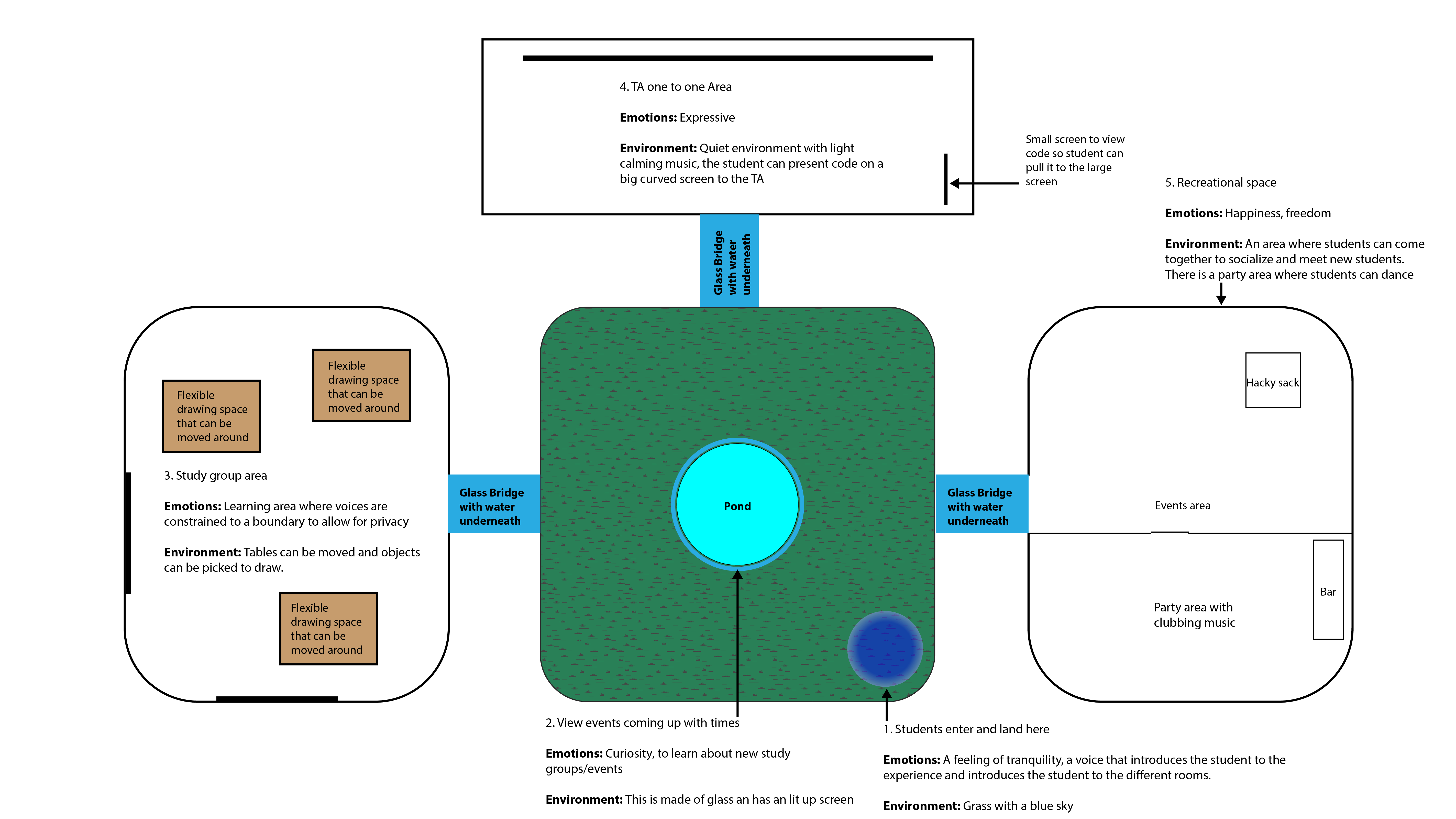
Diagramming
A diagram was then created to identify the main functions of each space, emotions the space evokes and the environment. The final experience however combines the study group and one to one space and omits the recreation space.
User Testing
After the ideation phase, I conducted three user tests and gained insights which shaped the final prototype. (Hover to read insights)
Whiteboard Height
The first user test was for the whiteboard with code on it. The insight I got was that it was hard for users 5′ or less to view the code. Since I was casting the experience on my laptop, I asked the user to point to to the line to which she could read the code.
Onboarding
Initially I had placed the Onboarding instructions for the experience were close to the dashboard with event information. The feedback I got was that the user wanted to see it right before entering the 1:1 space.
Whiteboard Markers
All the users liked the marker feature and found it convenient, however they mentioned they wanted the markers to have a more natural feel.
Final Prototype Video
My capstone project comprised setting up a VR project from scratch, developing, implementing the C# code and designing its main features. With extra time, I would like to expand this experience by adding separate recreation and study group spaces.
Next Steps
The aim of this project was to solve the problem students have with the hybrid mode of education which I solved. I set out to create an experience in virtual reality where students could meet their TA’s as well as collaborate with other students with similar interests. The scope originally was to provide students with three separate spaces and a central space each with their own experience, however because of time constraints it was narrowed down to a central and the 1:1 space. Moving forward I would like to conduct more user tests and keep developing this experience with more functionality.
© 2025 Tarun Hari copyright all right reserved.